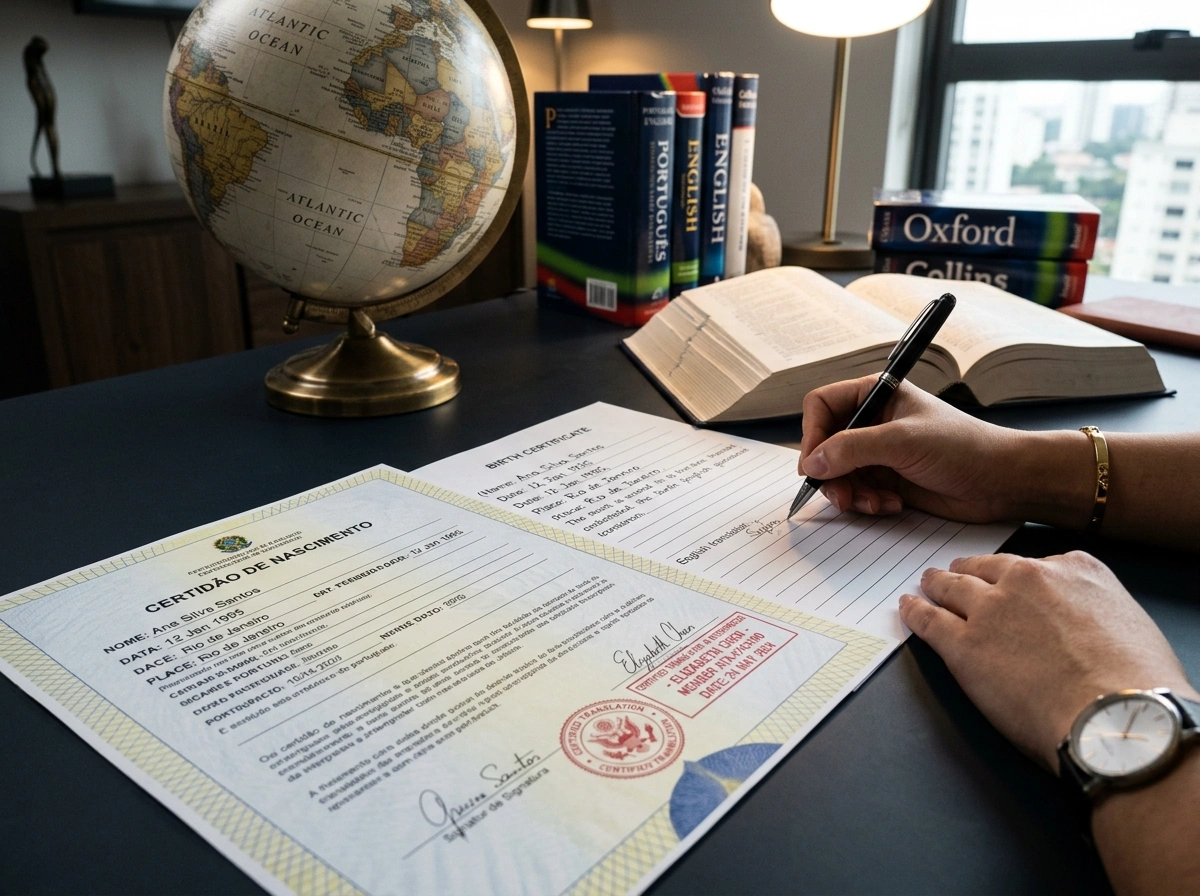
Moving to a new country, expanding a business internationally, or applying to a foreign university requires a massive amount of paperwork. You gather your birth certificates, academic transcripts, and financial records, ready to submit your application. But when those documents are in a different language than the official language of the receiving institution, you hit a major roadblock. A simple, rough translation done by a bilingual friend will not be accepted. You need something much more rigorous to prove the authenticity of your documents.
Institutions, courts, and government agencies rely on strict verification processes to prevent fraud and ensure clear communication. They cannot simply trust that a document says what the applicant claims it says. This creates a critical need for an authorized, legally binding conversion of your paperwork. Without this verified translation, your immigration application could be delayed, your business contract might be deemed invalid, and your university admission could be rejected.
Understanding the specific requirements for document translation can save you from costly delays and frustrating rejections. Navigating the world of certified documents, notarization, and apostilles might seem complicated at first glance. However, learning the basics will empower you to handle your international affairs smoothly. This guide explains everything you need to know about official translation, how it differs from standard translation, and why it plays such a vital role in global administrative processes.
Defining Official Translation: What It Is
An official translation is a legally valid translation of a document that is recognized by a government, court, or educational institution. Unlike standard translations used for casual reading or internal business communication, an official translation must meet strict regulatory standards. It serves as a true, accurate, and complete rendering of the original document.
The primary goal of this translation type is to maintain the exact meaning, tone, and formatting of the original text. Translators who perform this work do not take creative liberties. They translate names, dates, seals, and signatures precisely as they appear. If a section of the original document is illegible, the translator must note that fact rather than guessing the content.
To be considered official, the translated document typically requires a signed statement from the translator or the translation agency. This statement, often called a Certificate of Accuracy, affirms that the individual is competent to translate the language pair and that the resulting text is a complete and exact translation of the source material. Government bodies like the United States Citizenship and Immigration Services (USCIS) require this specific certification for all foreign-language documents.
Key Differences Between Standard and Official Translation
People often confuse standard translation with official translation, leading to significant issues when submitting legal paperwork. Standard translation focuses on conveying the general meaning and flow of a text. It is ideal for marketing materials, website copy, literature, and internal company memos. In these cases, the translator might adapt cultural idioms or adjust sentence structures to make the text sound more natural to the target audience.
Official translation, on the other hand, prioritizes absolute literal accuracy over stylistic flow. The translator must preserve the exact structure of the original document, including tables, stamps, and margins. If a legal contract contains a long, complex sentence, the official translation will reflect that complexity rather than breaking it down for easier reading.
Another major difference lies in the accountability of the translator. A standard translation rarely requires a formal signature or legal guarantee. If a mistake occurs in a standard translation, it might cause a brief misunderstanding. If an error occurs in an official translation, the consequences can be severe. A mistranslated birth date or misspelled name can result in a rejected visa application or a dismissed court case. Because of these high stakes, official translations are accompanied by certifications, and the professionals who complete them are bound by strict ethical and professional standards.
Types of Official Translations
Depending on the requirements of the receiving institution, you may need a specific type of official translation. Understanding the distinctions between these categories is crucial for a successful submission.
Certified Translation
A certified translation includes a formal letter or statement signed by the translator or translation company representative. This Certificate of Accuracy states that the translation is correct and complete. In the United States, certified translations are the standard requirement for USCIS submissions, university admissions, and most state and federal government applications. You do not always need a certified translator to provide a certified translation; however, the person or agency providing the service must guarantee their competence and the document’s accuracy.
Notarized Translation
Sometimes, an institution will request a notarized translation. This process involves a Notary Public. The translator signs the Certificate of Accuracy in the presence of the Notary Public, who then stamps and signs the document to verify the translator’s identity. The Notary Public does not check the quality or accuracy of the translation itself. They simply provide an extra layer of fraud prevention by confirming the identity of the person signing the certification. Notarized translations are frequently required by civil and criminal courts, the DMV, and for marriage license applications.
Apostille Translation
An apostille is a highly specialized form of authentication used for international matters. Under the Hague Convention, participating countries agree to recognize public documents issued by other member countries if they carry an apostille certificate. If you are submitting a U.S. document (like a background check or corporate agreement) to a foreign government, you must first get the original document apostilled by the Secretary of State. The translation of that document may also require a specific authentication process. Apostilles are common for international business operations, foreign citizenship applications, and overseas real estate purchases.
Why Official Translation Is Important
The necessity of verified translation services spans across multiple sectors. Government agencies and private institutions rely on these documents to make critical, life-altering decisions.
Legal and Regulatory Compliance
Courts and legal systems demand absolute precision. When presenting evidence, depositions, contracts, or judgments originating in a foreign language, the court must be entirely certain of the document’s contents. An official translation ensures that all parties involved in a legal dispute have access to the exact same information. Without it, opposing counsel could argue that the translation is biased or inaccurate, potentially invalidating crucial evidence. Regulatory bodies also require certified translations for patents, trademark filings, and compliance reports to ensure companies adhere to local laws.
Immigration and Visa Processes
Immigration authorities deal with millions of applications every year. Organizations like USCIS require applicants to submit extensive personal documentation, including birth certificates, marriage certificates, divorce decrees, and police records. Because immigration officers cannot read every global language, they mandate certified translations that adhere to specific federal regulations (such as 8 CFR 103.2). A single error in translating a date or a legal term on a vaccination record can lead to a Request for Evidence (RFE), severely delaying the immigration process or causing an outright denial.
Academic and Professional Recognition
Students applying to colleges or universities abroad must prove their academic history. Admissions boards need to evaluate foreign diplomas, academic transcripts, and letters of recommendation to determine if a student meets their entry criteria. Official translations allow credential evaluation agencies to accurately convert foreign grading systems into the local equivalent. Similarly, professional licensing boards for medicine, nursing, and engineering require certified translations of foreign credentials to ensure that an applicant’s training meets national safety and educational standards.
International Business Transactions
When companies expand across borders, they must navigate a maze of foreign corporate laws. Financial statements, articles of incorporation, employee handbooks, and tax returns must be translated for foreign partners, banks, and tax authorities. Official translations provide a secure foundation for international business transactions. They guarantee that a contract signed in Tokyo holds the exact same legal weight and meaning when reviewed by a corporate board in New York. This accuracy prevents costly litigation and builds trust between international partners.
The Process of Obtaining an Official Translation
Acquiring a certified or notarized translation is typically a straightforward, highly digital process. Gone are the days when you had to mail your original, irreplaceable birth certificate to a translation agency.
First, you prepare your documents. You can simply take a clear, well-lit photograph of the document or scan it to create a PDF. Ensure that all edges are visible and that stamps, signatures, and fine print are easily readable.
Next, you upload the digital file to a secure portal provided by the translation service. The agency will review the document, calculate the word count or page count, and provide an exact price quote.
Once you approve the quote and place the order, a professional translator takes over. They will carefully translate the text, preserving the layout and formatting of the original file. After completing the translation, the agency attaches a signed Certificate of Accuracy.
Finally, the agency delivers the completed translation. In most cases, you will receive a secure PDF file via email, which is perfectly acceptable for USCIS and many online university portals. If you require a physical copy with a wet ink signature or a notary stamp, the agency will mail the hard copy directly to your home or office.
Choosing the Right Translation Service
Selecting a reliable provider is the most critical step in this process. Using an inexperienced freelancer or an automated AI tool for legal documents will almost certainly result in rejection. When evaluating translation services, look for specific trust signals and guarantees.
First, verify that the agency guarantees acceptance by the organization you are submitting to. If you need a document for immigration, the agency should explicitly state that their translations meet USCIS requirements.
Second, check their professional affiliations. Agencies that hold corporate membership with the American Translators Association (ATA) generally adhere to high ethical and professional standards. Better Business Bureau (BBB) accreditation is another strong indicator of a trustworthy, customer-focused business.
Third, look for transparent pricing. Reputable agencies usually charge a flat rate per page (for example, around $29.95 per page) rather than surprising you with hidden fees based on complex vocabulary. Ensure they offer a clear breakdown of optional add-ons, such as notarization fees or expedited processing costs.
Finally, consider their language offerings and turnaround times. A strong agency will support dozens of languages and can typically turn around standard documents within one to three business days. They should also offer secure handling of your data, protecting your sensitive personal and financial information throughout the transaction.
Frequently Asked Questions
To provide further clarity, here are some common questions individuals have when navigating the document translation process.
Do I need to send my original documents to the translator?
No. Reputable online translation agencies do not require you to mail your original, physical documents. You can safely upload a clear scan or a high-quality photo of your document through a secure online portal. The translated documents are then delivered to you digitally as a PDF, with hard copies mailed upon request. Your original documents remain safely in your possession.
How much does an official translation usually cost?
Pricing varies depending on the provider, but many transparent services charge a flat rate per page. A standard page usually costs between $25 and $35. Additional services, such as adding a U.S. notary seal, requiring expedited turnaround, or obtaining an apostille authentication, will incur extra charges.
How quickly can a document be translated?
For standard personal documents like a birth certificate or driver’s license, the turnaround time is usually between one and three business days. If you are facing a tight deadline, many agencies offer expedited processing or rush services that can deliver the certified translation in 24 hours or less.
What is a Certificate of Accuracy?
A Certificate of Accuracy is a formal, signed statement attached to the translated document. It contains the translator’s or agency’s contact information, a declaration of their competence in the specific language pair, and a legally binding statement that the translation is an accurate and complete rendering of the original document. This certificate is what makes the translation “certified.”
Can I translate my own documents if I am fully bilingual?
No. Even if you are completely fluent in both languages, government agencies like USCIS do not allow you to translate your own documents. The translation must be completed by an objective, independent third party to avoid conflicts of interest and ensure unbiased accuracy.
Secure Your Global Endeavors with Confidence
Dealing with international paperwork is often stressful, but obtaining the correct documentation does not have to be a painful experience. By understanding the distinct differences between standard, certified, notarized, and apostille translations, you can confidently prepare your applications for any global institution.
Always prioritize accuracy, strict formatting, and regulatory compliance over cheap, automated alternatives. Whether you are applying for a green card, submitting evidence to a federal court, or enrolling in a prestigious university abroad, a professionally certified translation protects your hard work. Choose a reputable, transparent service provider to bridge the language gap, ensuring that your official documents are recognized, respected, and accepted anywhere in the world.
